
Support Portal
Discover our Support Portal, your one-stop destination for accessing essential resources such as brochures, product datasheets, operation guides, and more.
Explore
Pilot Wireless Network

Small Cell

Drive Test/Outdoor Test

Indoor Test

Autonomous Measurement

Laboratory Automation

Post Processing

Drone-based Testing
Dingli's Pilot Wireless Network Solution is instrumental in ensuring seamless signal transmission between base stations and mobile devices. This cutting-edge solution is tailored to improve the performance, reliability, and efficiency of wireless networks, delivering enhanced network quality and user experience.
Read More Find the related productsSmall Cell Networks power the next wave of wireless innovation, delivering high-quality, reliable connectivity for demanding environments like smart enterprises and hospitals
Read More Find the related productsDingli's LTE drive test solutions give mobile operators real-world visibility into outdoor 4G and 5G performance, measuring coverage, signal quality, throughput, handover and service experience along defined test routes.
Read More Find the related productsIndoor cellular coverage tester solutions evaluate and optimize networks in malls, hospitals, offices, residences, schools, and underground parking lots.
Read More Find the related productsAutonomous Measurement uses advanced tools to monitor and validate network performance, streamlining evaluation and reducing manual effort.
Read More Find the related productsLab test solutions verify 4G/5G performance and reliability before deployment, ensuring every component meets the highest standards
Read More Find the related productsDingli provides cutting-edge Post Processing solutions and a powerful software platform for network analysis and benchmarking, maximizing performance and reliability.
Read More Find the related productsDingli Drone-Based Testing is an automated solution designed for the emerging low-altitude economy, enabling precise 5G vertical coverage analysis.
Read More Find the related products
Enables seamless smart applications, reliable connectivity, and enhanced driving safety

This cost-effective NB-IoT testing and eMTC testing solution includes essential measurements, signaling tests, failure alarms, and post-processing.

Measure QoS and QoE for all OTT applications and services
Accelerate digital transformation with 5G private network testing that improves reliability, efficiency and productivity.

Measures and analyzes network performance for low-altitude cellular networks

Verify QoE in 5G networks with a scalable multiple network benchmarking solution and ensure the competitiveness of your network.

Increase the efficiency of your site verification and accelerate your 5G roll-out

Ensure network quality and end-user satisfaction of wireless networks with professional in-building measurement

Automated VoLTE testing gives mobile voice service providers an end-to-end way to measure voice quality and improve customer experience.

Ensure the performance of your 5G network indoors, benchmark your network against competitors

Dingli enhances outdoor network coverage with advanced 4G-5G RAN solutions, bridging the digital gap for urban and rural areas.

Dingli's Private Network Solutions offer secure, customizable, and efficient wireless communication for businesses, enhancing connectivity and operational efficiency.

Dingli's IoT Solutions offer innovative and scalable Internet of Things technologies, enabling smart connectivity and data-driven insights across various industries.

FWA, Fixed Wireless Access, provides high-speed broadband internet via wireless communication, bridging the digital divide in underserved areas.

Dingli excels in Indoor Network solutions, merging 4G reliability with swift 5G speeds for seamless mobile coverage in businesses and public spaces.

Elevator Networks, designed for elevators, uses 5G for high-speed connectivity, real-time monitoring, and seamless communication.

Drive testing uses a vehicle-mounted scanner or UE to capture RF performance along roads and highways at driving speed, while walk testing uses handheld or backpack-mounted equipment to measure signal quality at pedestrian speed, typically indoors or in dense pockets. Choose drive testing for outdoor coverage, mobility, and handover validation across wide areas; choose walk testing for indoor coverage gaps, in-building DAS acceptance, and localized KPI troubleshooting where vehicles simply can't go. The two methods aren't competing standards. They're complementary tools that answer different questions about the same network.
Key takeaways
Ask ten RF engineers to define these two methods and you'll get ten slightly different answers, but the core distinction is mobility. A drive test mounts a scanner or test UE inside a vehicle, pairs it with an external GPS antenna, and logs RF data continuously as the vehicle moves along a planned route at traffic speed. A walk test does the same job conceptually, but the operator carries the equipment on foot, often indoors where GPS can't reach.
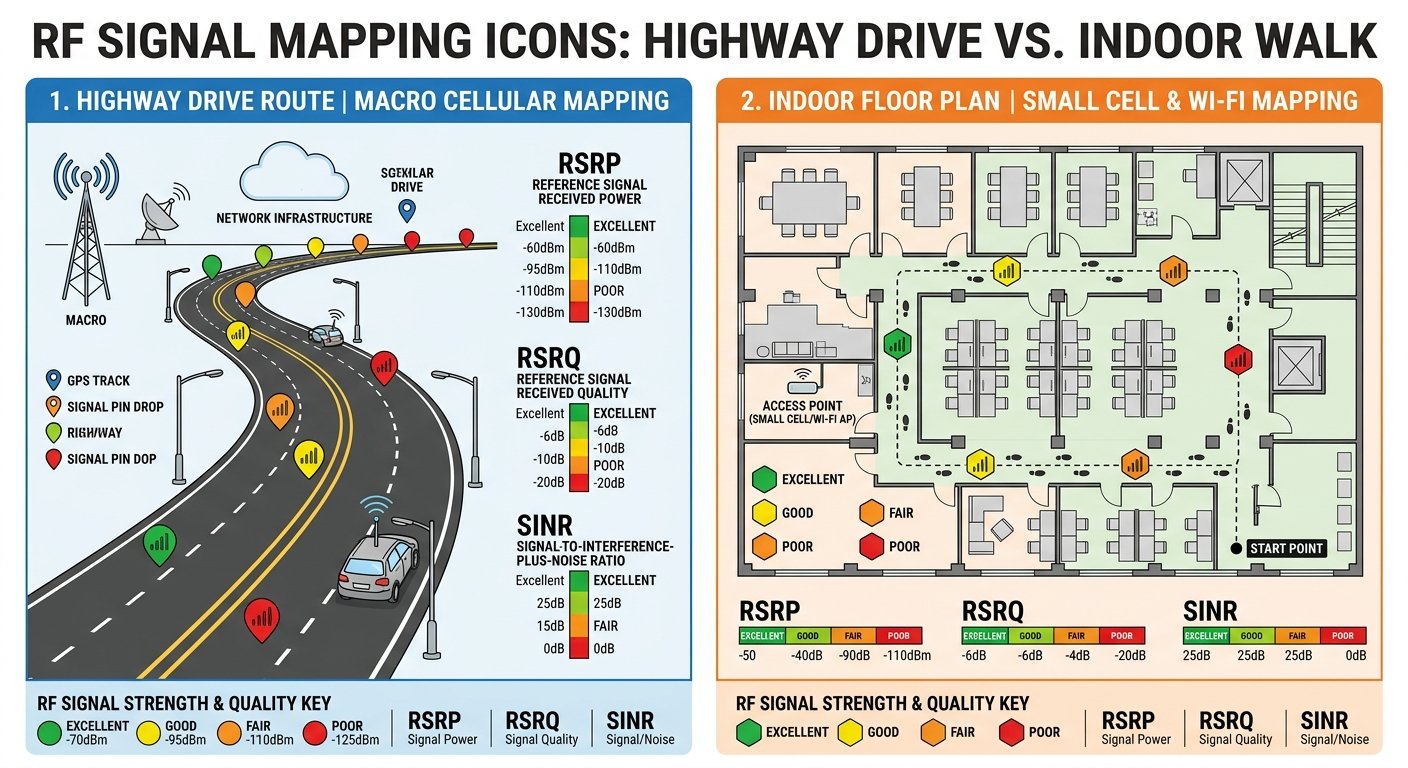
Both methods capture the same underlying metrics: RSRP, RSRQ, SINR, throughput, and call setup performance. What changes is the mobility profile, and that matters more than it sounds. At vehicle speed, Doppler shift and rapid cell transitions create handover events that simply don't happen the same way when someone is walking down a hospital corridor at a slow, steady pace. Drive testing in telecom has evolved specifically to capture this mobility-dependent behavior, which is why it remains the default for outdoor validation.
Dingli's LTE drive test solutions measure coverage, signal quality, throughput, handover and service experience for outdoor 4G and 5G networks, while its indoor test solutions are built to evaluate and optimize networks in malls, hospitals, offices, residences, schools, and underground parking lots. Two different toolsets for two different physics problems.
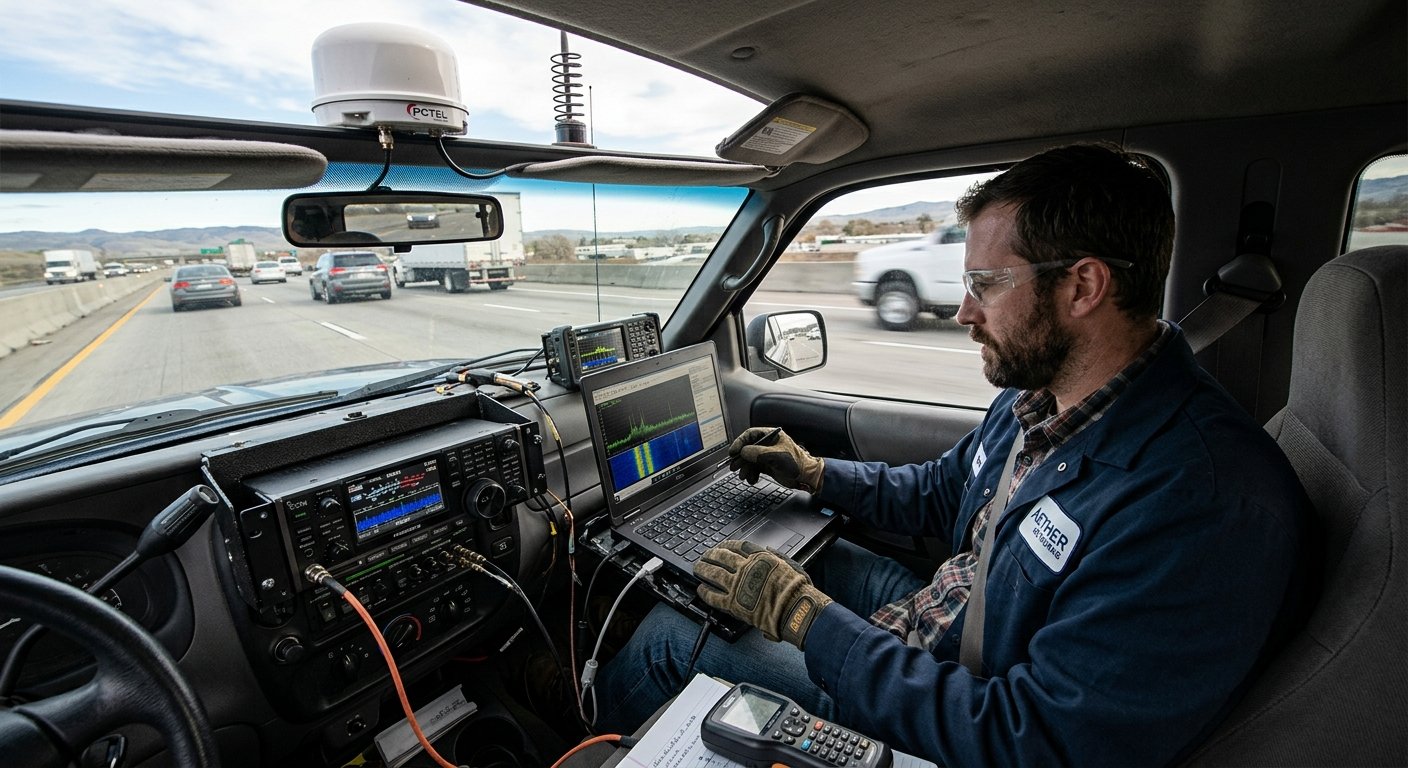
Buy the wrong rig and you'll find out the hard way, usually halfway through a floor-by-floor DAS acceptance test with a vehicle-grade setup that won't fit in a service elevator. Drive test rigs are built around in-vehicle scanner or UE arrays, an external GPS antenna mounted on the roof or window, and a ruggedized logging laptop that can survive hours on bumpy roads.
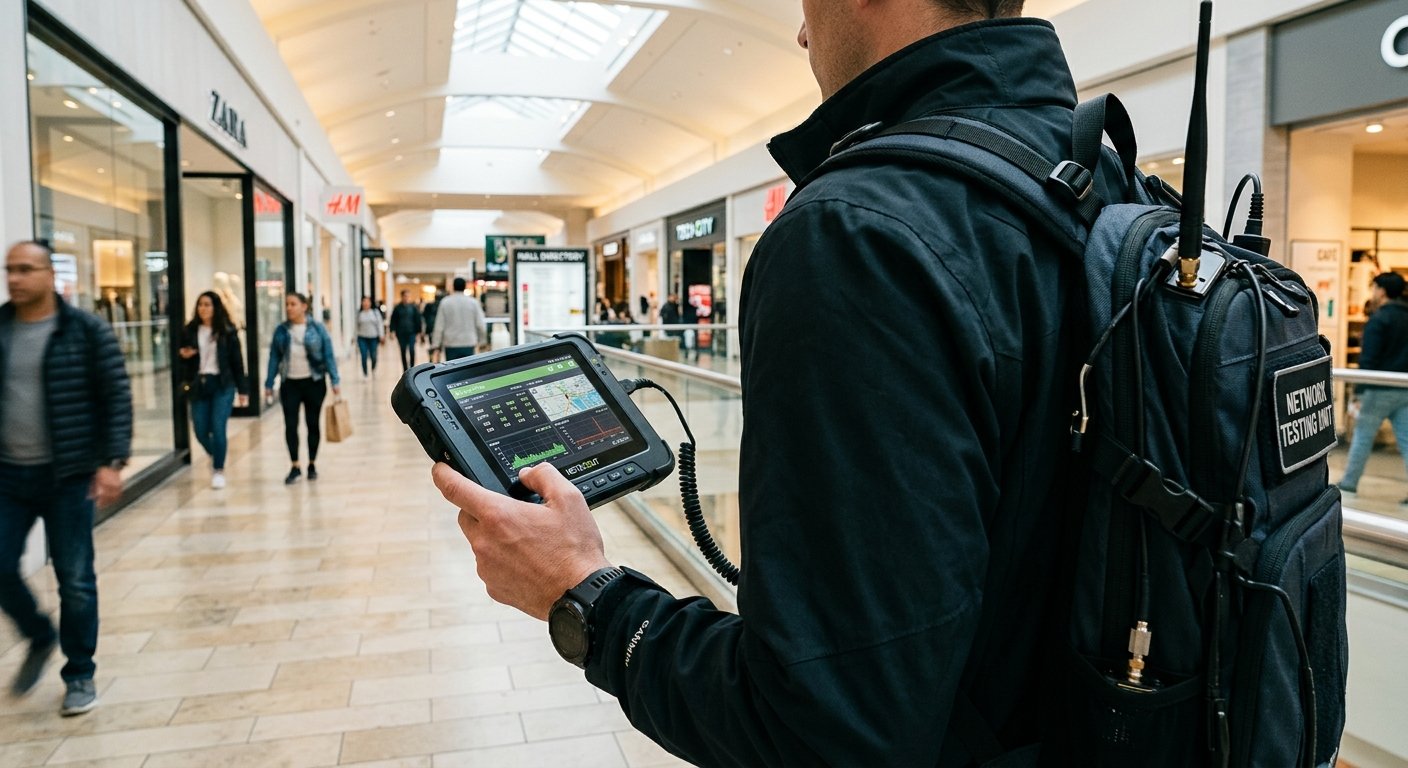
Walk test rigs trade size for portability. Backpack or handheld UE units need to go through corridors, stairwells, and elevators without slowing the operator down or drawing attention in a hospital lobby. The bigger practical headache is positioning. GPS signal degrades or disappears entirely indoors, so walk tests rely on floor plans with manually marked waypoints, or Bluetooth/Wi-Fi beacon triangulation, instead of satellite positioning.
Route planning follows the same split. Drive test routes are drawn over road networks and highway segments. Walk test routes are drawn over building floor plans, following pedestrian paths that a vehicle could never access. Dingli's Pilot Wireless Network category includes products built for both: Pilot Walktour, Pilot Fleet Edge, Pilot Performer, Pilot Pioneer, Pilot Foresight, Pilot LiteProbe, Pilot Matrix, Pilot Scout, Pilot Pioneer Expert, and Pilot Walktour Pack, with Pilot Walktour Pack, Pilot Walktour, Pilot Foresight, and Pilot Pioneer specifically suited to indoor test scenarios.
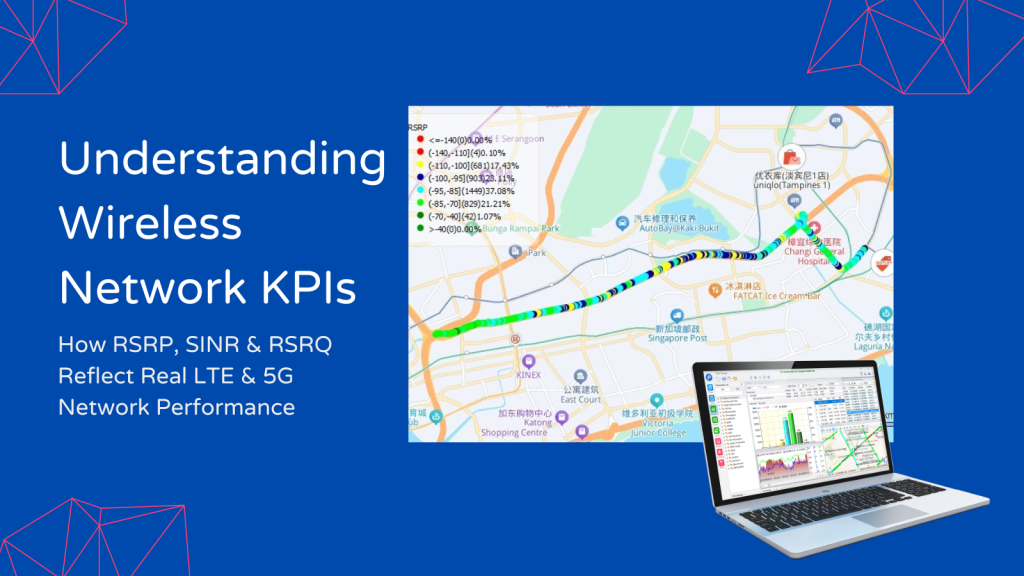
Not every KPI makes sense at every speed. That's the part generic comparisons miss entirely. Drive testing is the right tool for RSRP/RSRQ/SINR mapping across wide corridors, handover success rate between cells, throughput measured over distance, and cross-cell mobility behavior. These are all metrics that only mean something when the device is actually moving between cells.
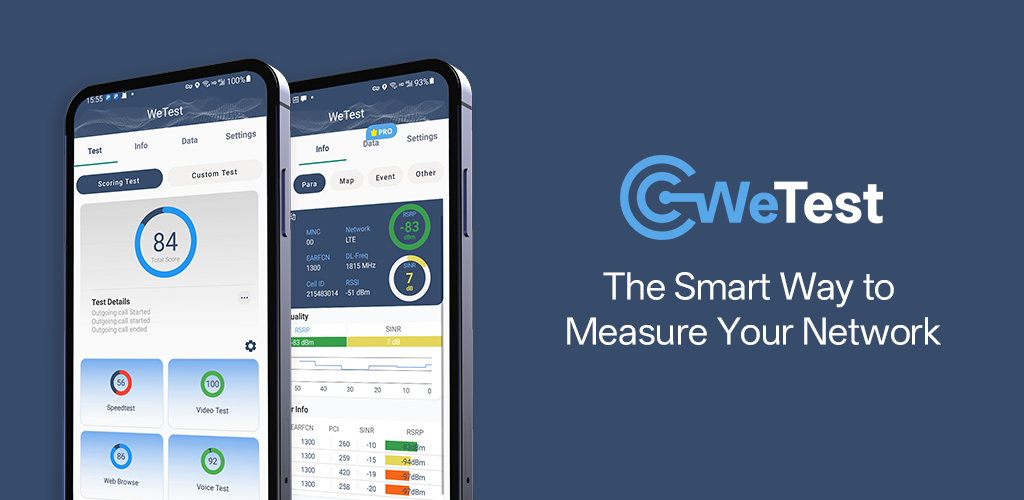
Walk testing earns its place on different ground: localized coverage holes, indoor signal quality in a specific room or floor, VoLTE/VoNR MOS scores isolated from mobility noise, and dense small-cell validation where coverage changes every few meters. Handover KPIs still make the most sense in drive tests, since that's where real cell-to-cell transitions at speed actually occur.
MOS and QoE testing for VoLTE/VoNR, on the other hand, often makes more sense at walking pace. Call setup and voice quality are easier to isolate from mobility-induced handovers when the test device isn't jumping between cells every few seconds. Dingli's drive testing solutions support measurement and analysis of network coverage, signal quality, throughput, handover performance, and service experience, while its VoLTE/VoNR MOS testing solution and Precision Indoor Measurement offering are built around exactly this kind of localized, low-mobility voice and QoE evaluation.
| Criteria | Drive Test | Walk Test |
|---|---|---|
| Mobility profile | Vehicle speed, continuous motion | Pedestrian pace, frequent stops |
| Best KPI fit | Handover success, throughput over distance | Localized coverage, VoLTE/VoNR MOS |
| Doppler/interference impact | Higher, affects SINR and handover | Minimal, cleaner isolated readings |
Dingli offers an Outdoor Mobile Coverage solution using advanced 4G-5G RAN to bridge digital gaps in urban and rural areas, and a Multiple Network Benchmarking Test solution to verify QoE in 5G networks.
Indoor network testing applications commonly include commercial buildings, hospitals, schools, and shopping malls. Dingli's In-building/Train/Metro Networks Measurement solution is built to ensure 5G network performance indoors and benchmark against competitors, and its Elevator Networks solution addresses connectivity in one of the hardest-to-test confined spaces in any building.
Most inconsistent test results don't come from bad equipment. They come from comparing numbers that were never meant to be compared in the first place. GPS accuracy drops indoors, often significantly, which means walk test logs geotagged with degraded GPS can misplace a coverage issue by several meters, sometimes an entire room.
Here's a less obvious trap: SINR readings at walking speed can look noticeably better than drive test readings at the same physical location. That's not a measurement error. Reduced Doppler-induced interference at low mobility genuinely produces cleaner SINR values. Treating that difference as a network improvement, instead of a methodology artifact, leads straight to wrong conclusions.
Route repeatability is another quiet source of error. Drive test routes are easy to standardize because GPS waypoints lock the path down precisely. Walk test routes depend on the operator maintaining a consistent pace and marking waypoints accurately, which introduces more variability between test runs than most teams account for. Bottom line: never compare drive test and walk test results for the same KPI without first normalizing for mobility differences. Treat them as two separate baselines, not two samples of the same thing.
Manual driving and walking are still the backbone of field validation, but they're not the whole story anymore. Autonomous measurement platforms now replace manual driving and walking with scheduled, repeatable test runs, cutting down on the pacing and route variability discussed above. Dingli's Lab Networks Autonomous Measurement solution is designed to increase efficiency of site verification and accelerate 5G roll-out, moving part of the validation burden off manual field crews.
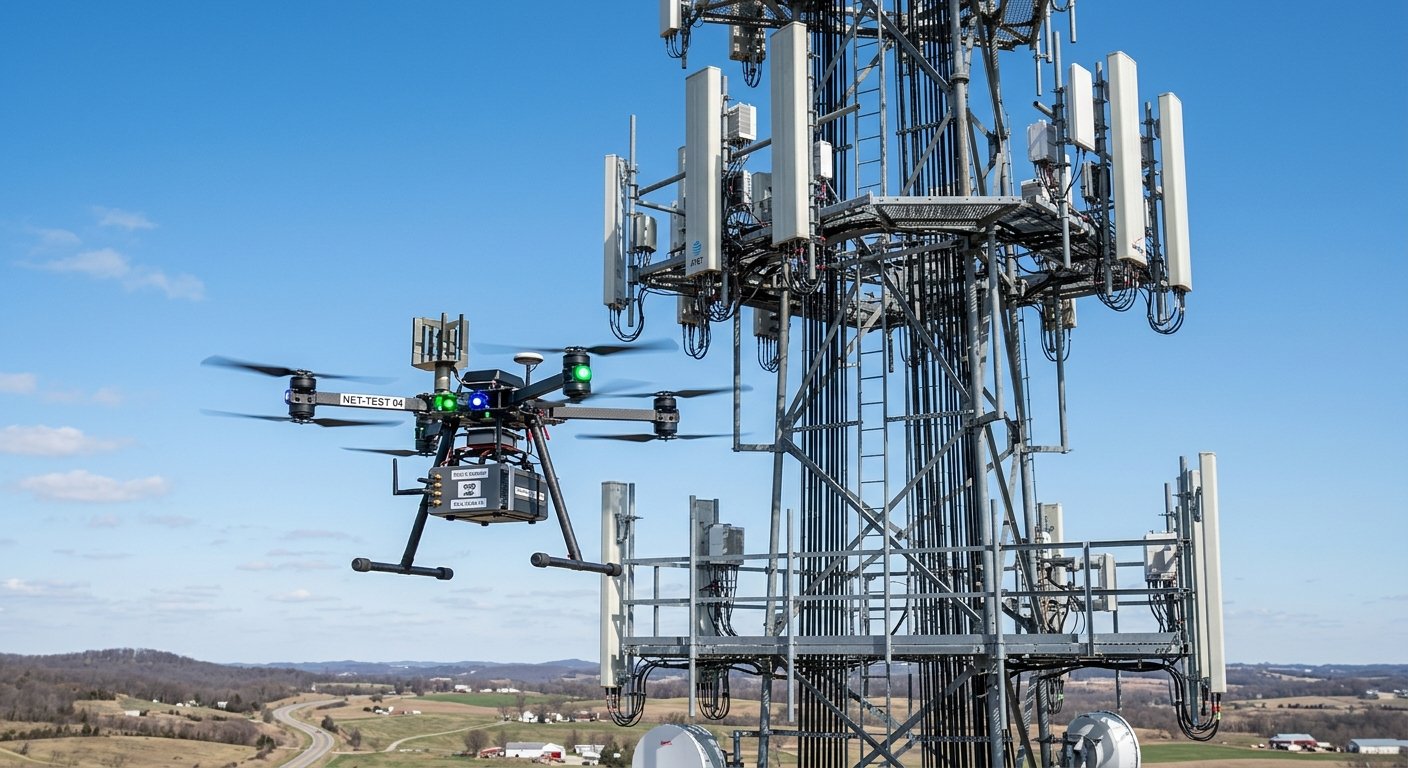
Drone-based testing is the other emerging piece. It captures vertical coverage and hard-to-reach outdoor areas without needing a vehicle route or a pedestrian path at all, relevant for rooftop coverage, tower clusters, and the growing low-altitude economy. Dingli's drone-based testing is an automated solution for 5G vertical coverage analysis in exactly this space.
Before any of this reaches the field, laboratory automation can verify 4G/5G performance and reliability ahead of deployment. And once data starts coming in from multiple sources, post-processing platforms support network analysis and benchmarking, giving engineers a more structured way to work through results from different test campaigns. See the role of automation in mobile network performance monitoring for more on where this is heading.
Stop treating this as an either/or decision. Most mature networks need both methods, just at different stages. Use this checklist before planning your next campaign:
As a rule of thumb, drive testing handles wide-area rollout validation under real mobility conditions, while walk testing handles in-building acceptance once the network is live. Automation and post-processing tools reduce the manual effort either method requires, letting teams run more test cycles without scaling headcount.
For teams building out a testing program, Dingli's Pilot Walktour and Pilot Pioneer cover much of this ground directly, with Pilot Walktour Pack, Pilot Matrix, and Pilot Scout rounding out outdoor and indoor coverage needs. Browse the resource library for product brochures and technical datasheets before scoping your next field campaign.



If you are interested in our services or need customized solutions, please feel free to contact us
Contact UsComplete the form below to have a sales person address your business needs.

