
Support Portal
Discover our Support Portal, your one-stop destination for accessing essential resources such as brochures, product datasheets, operation guides, and more.
Explore
Pilot Wireless Network

Small Cell

Drive Test/Outdoor Test

Indoor Test

Autonomous Measurement

Laboratory Automation

Post Processing

Drone-based Testing
Dingli's Pilot Wireless Network Solution is instrumental in ensuring seamless signal transmission between base stations and mobile devices. This cutting-edge solution is tailored to improve the performance, reliability, and efficiency of wireless networks, delivering enhanced network quality and user experience.
Read More Find the related productsSmall Cell Networks power the next wave of wireless innovation, delivering high-quality, reliable connectivity for demanding environments like smart enterprises and hospitals
Read More Find the related productsDingli's LTE drive test solutions give mobile operators real-world visibility into outdoor 4G and 5G performance, measuring coverage, signal quality, throughput, handover and service experience along defined test routes.
Read More Find the related productsIndoor cellular coverage tester solutions evaluate and optimize networks in malls, hospitals, offices, residences, schools, and underground parking lots.
Read More Find the related productsAutonomous Measurement uses advanced tools to monitor and validate network performance, streamlining evaluation and reducing manual effort.
Read More Find the related productsLab test solutions verify 4G/5G performance and reliability before deployment, ensuring every component meets the highest standards
Read More Find the related productsDingli provides cutting-edge Post Processing solutions and a powerful software platform for network analysis and benchmarking, maximizing performance and reliability.
Read More Find the related productsDingli Drone-Based Testing is an automated solution designed for the emerging low-altitude economy, enabling precise 5G vertical coverage analysis.
Read More Find the related products
Enables seamless smart applications, reliable connectivity, and enhanced driving safety

This cost-effective NB-IoT testing and eMTC testing solution includes essential measurements, signaling tests, failure alarms, and post-processing.

Measure QoS and QoE for all OTT applications and services

Accelerate digital transformation with 5G private network testing that improves reliability, efficiency and productivity.

Measures and analyzes network performance for low-altitude cellular networks

Verify QoE in 5G networks with a scalable multiple network benchmarking solution and ensure the competitiveness of your network.

Increase the efficiency of your site verification and accelerate your 5G roll-out

Ensure network quality and end-user satisfaction of wireless networks with professional in-building measurement

Automated VoLTE testing gives mobile voice service providers an end-to-end way to measure voice quality and improve customer experience.

Ensure the performance of your 5G network indoors, benchmark your network against competitors

Dingli enhances outdoor network coverage with advanced 4G-5G RAN solutions, bridging the digital gap for urban and rural areas.

Dingli's Private Network Solutions offer secure, customizable, and efficient wireless communication for businesses, enhancing connectivity and operational efficiency.

Dingli's IoT Solutions offer innovative and scalable Internet of Things technologies, enabling smart connectivity and data-driven insights across various industries.

FWA, Fixed Wireless Access, provides high-speed broadband internet via wireless communication, bridging the digital divide in underserved areas.

Dingli excels in Indoor Network solutions, merging 4G reliability with swift 5G speeds for seamless mobile coverage in businesses and public spaces.

Elevator Networks, designed for elevators, uses 5G for high-speed connectivity, real-time monitoring, and seamless communication.

VoLTE and VoNR testing differ mainly in the call-flow path being validated: EPS fallback and anchored LTE signaling for VoLTE versus native 5G SA voice bearers for VoNR. That architectural split changes which KPIs you measure, how call setup time and MOS get captured, and most critically, what network mode must actually be present for the test to be valid at all. Get the mode wrong and you will test VoLTE while believing you tested VoNR, and no amount of post-processing fixes that.
Key takeaways
The real difference between VoLTE and VoNR comes down to which core network carries the call. VoLTE carries voice as IMS-based VoIP over the LTE Evolved Packet Core (EPC), using SIP signaling over a dedicated bearer tagged with QCI 1 to guarantee low latency and priority handling. VoNR does the same job but skips the EPC detour entirely: voice is carried natively over the 5G NR air interface and the 5G Core (5GC), with SIP signaling riding on 5G QoS flows instead of EPS bearers.
That sounds like a minor plumbing difference until you hit the NSA/SA wall. VoNR is only possible on a genuine 5G Standalone (SA) deployment; on Non-Standalone (NSA) 5G, voice calls fall back to LTE regardless of what the data session is doing. Section 5 covers exactly why that happens.
Why does a test engineer need to care this much? Because testing 'VoNR' on an NSA network will silently produce VoLTE results. The call connects, the audio sounds fine, the KPIs look normal, and none of it tells you anything about native 5G voice performance. Confirming network mode before the first test call is not optional.
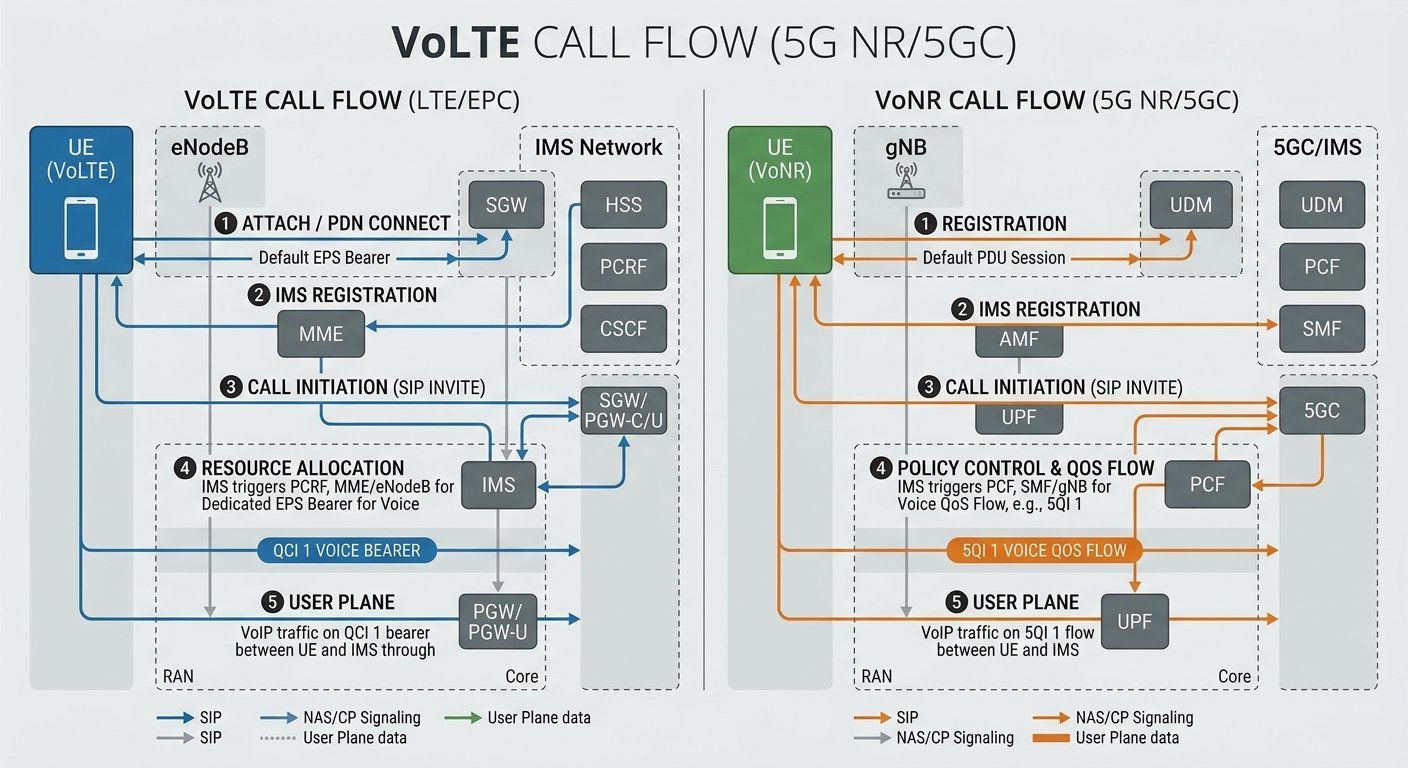
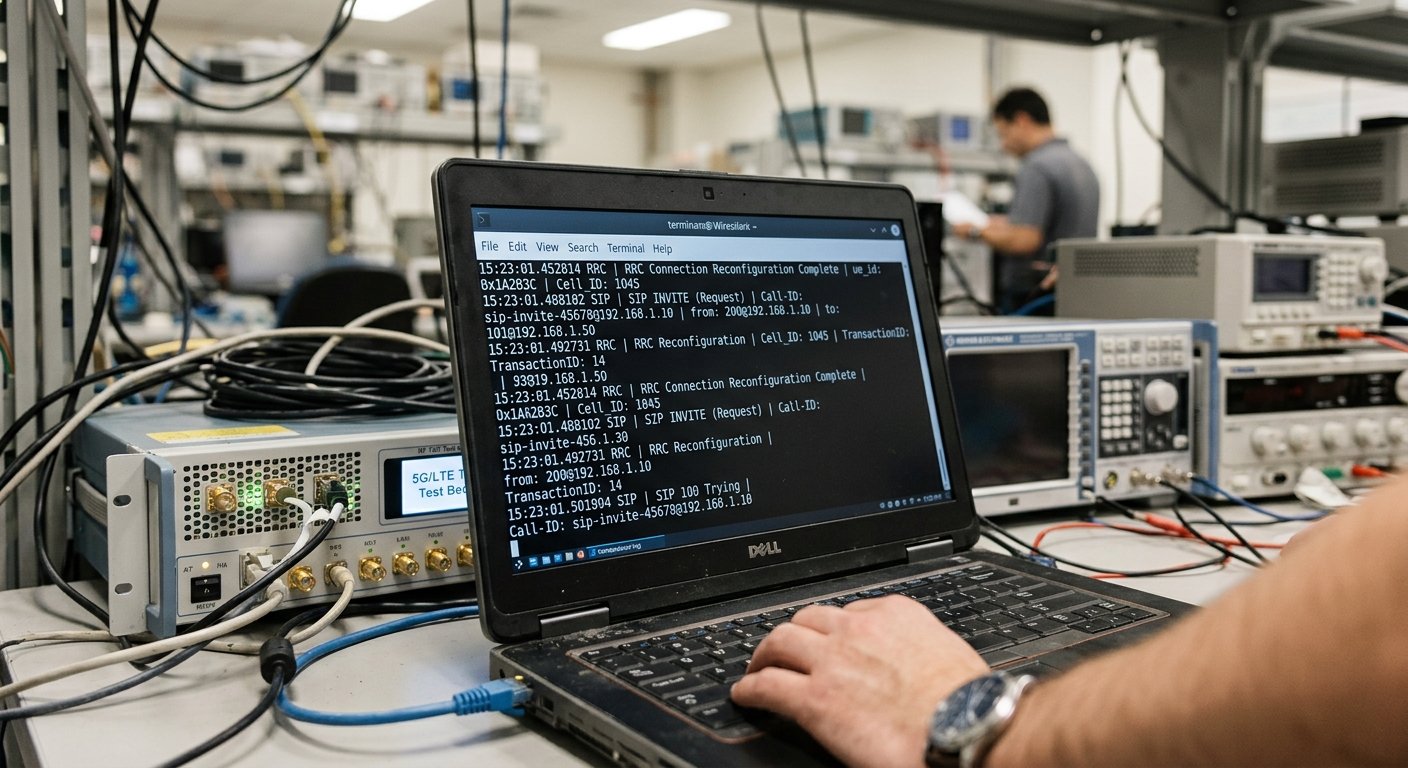
Call setup on VoLTE follows a predictable sequence: IMS registration over LTE, a SIP INVITE/180 Ringing/200 OK exchange, dedicated bearer establishment, and finally an RTP media path carrying the actual voice packets. Every one of those steps adds latency, and every one shows up in a drive test log as a discrete signaling event.
VoNR's call flow is leaner. IMS registration happens over 5G NR, SIP signaling is carried over NR QoS flows, and there's no bearer-to-EPS mapping step to wait for. Fewer moving parts, in theory, means faster call setup, assuming the UE actually stays on SA throughout.
EPS Fallback (EPSFB) happens when a UE sitting in 5G SA coverage initiates or receives a call, but the network decides to redirect it to LTE for the voice leg. This redirection inserts a measurable delay before SIP signaling even starts, since the UE has to complete an RRC reconfiguration to LTE first.
If you're logging a VoNR test campaign, capture the RRC reconfiguration or redirection message, timestamp the fallback trigger, and calculate the delta in call setup time versus a native SA voice call. Without that delta, you can't tell whether a slow call was a native VoNR call with a slow core, or a fallback call that never got the chance to be VoNR at all.
The KPI names stay the same between VoLTE and VoNR testing. What changes is what each KPI is actually capturing underneath.
| KPI | VoLTE | VoNR |
|---|---|---|
| Call Setup Time (CST) | Dial/SIP INVITE to 180 Ringing, includes LTE bearer setup and possible EPSFB redirection delay | End-to-end over NR, no EPS bearer wait, but still exposed to fallback if triggered |
| Call Drop Rate | Tracked per RAT, segmented by whether the call stayed on LTE throughout | Must be segmented by native VoNR, VoLTE fallback, or mid-call fallback drop |
| MOS (POLQA) | Reference vs degraded audio comparison, ITU-T P.863 methodology | Same methodology, different transport and codec path |
| Jitter / RTP delay / packet loss | Measured on RTP stream over EPS bearer | Measured on RTP stream over NR QoS flow |
The practical consequence: you cannot directly compare raw CST or drop rate numbers across a VoLTE campaign and a VoNR campaign without noting, for every single call, the RAT, the NSA/SA mode, and the fallback status. Blend those together and your averages mean almost nothing.
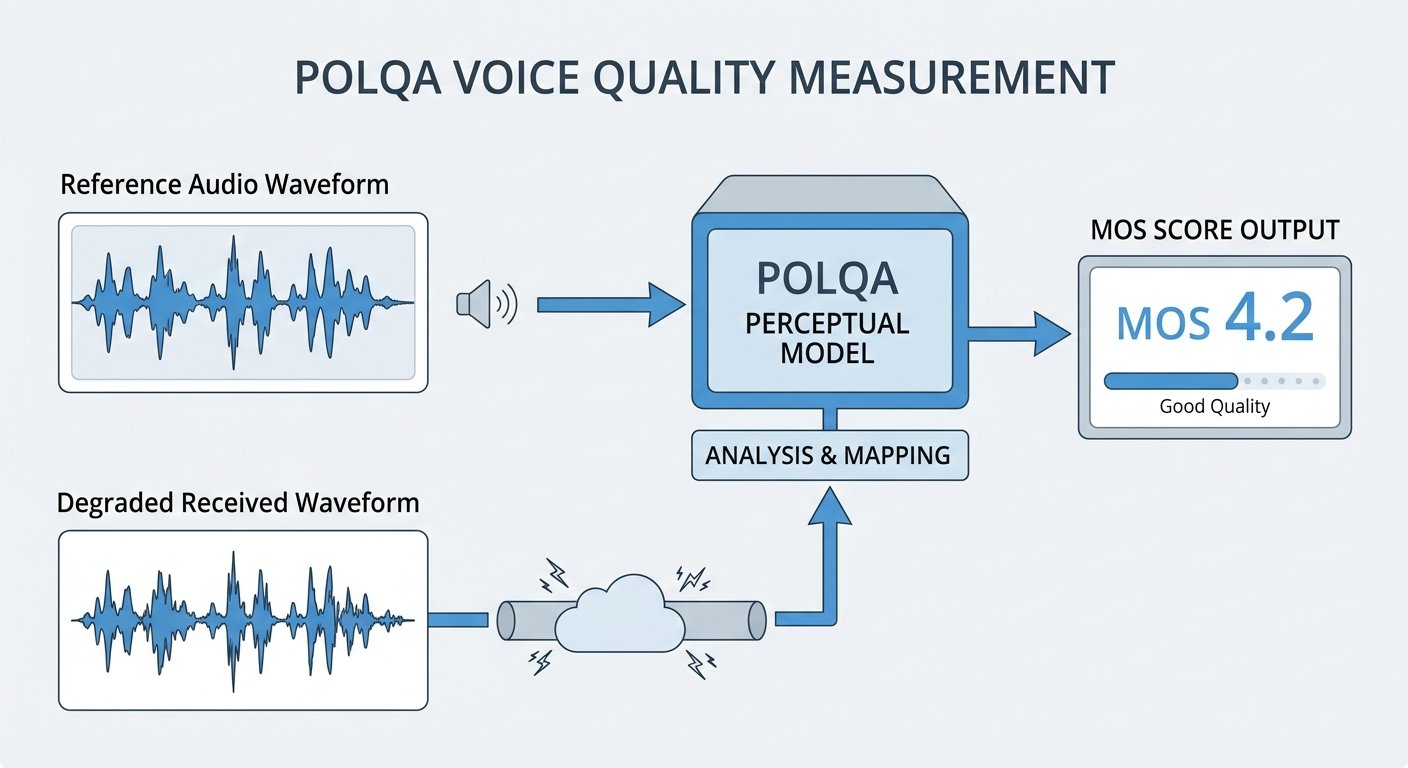
POLQA (ITU-T P.863) is a perceptual audio quality algorithm. It compares a known reference signal against the received, degraded signal and outputs a MOS-equivalent score. This is the same algorithm used for both VoLTE and VoNR MOS testing, the methodology doesn't change between technologies, only the path the audio travels.
In practice, VoLTE/VoNR MOS testing means playing a known reference audio sample at one end of a call, capturing the received signal at the other end, and running both through POLQA post-processing. Because the test is end-to-end, it captures codec performance, transcoding artifacts, jitter buffer behavior, and any RAT-specific impairments, not just raw radio signal quality.
This is where engineers sometimes conflate two very different things. MOS is a service-level voice quality score. SINR and RSRQ are radio signal quality measurements. A cell can report excellent SINR and still produce a poor MOS score if there's jitter buffer underrun, RTP packet loss, or a codec mismatch somewhere in the chain. Good radio does not guarantee good voice.
Dingli's VoLTE/VoNR MOS Testing solution is built around this end-to-end measurement approach, giving mobile voice service providers a way to measure voice quality rather than just radio conditions.
As noted earlier, an NSA network anchors its control plane to LTE, so voice always routes through VoLTE no matter which radio carries the data. There is no native VoNR path to test here, full stop.
On SA, the UE has a direct connection to the 5GC and can establish a native VoNR call. But EPS fallback can still happen depending on coverage gaps, network configuration, or UE capability limits. SA coverage is not a guarantee of a VoNR call.
This is a configuration and device-setting question for network planners, not a testing decision. From a validation standpoint, engineers should test both paths: the native VoNR path and the fallback path, because real subscribers will experience both depending on where they stand relative to SA coverage. Testing only one path gives you half the picture.
Before assuming any VoNR call in your logs was actually a VoNR call, confirm the network mode and the IMS/VoNR support flag on the device. Skipping this check is the single most common cause of mislabeled VoNR test results.
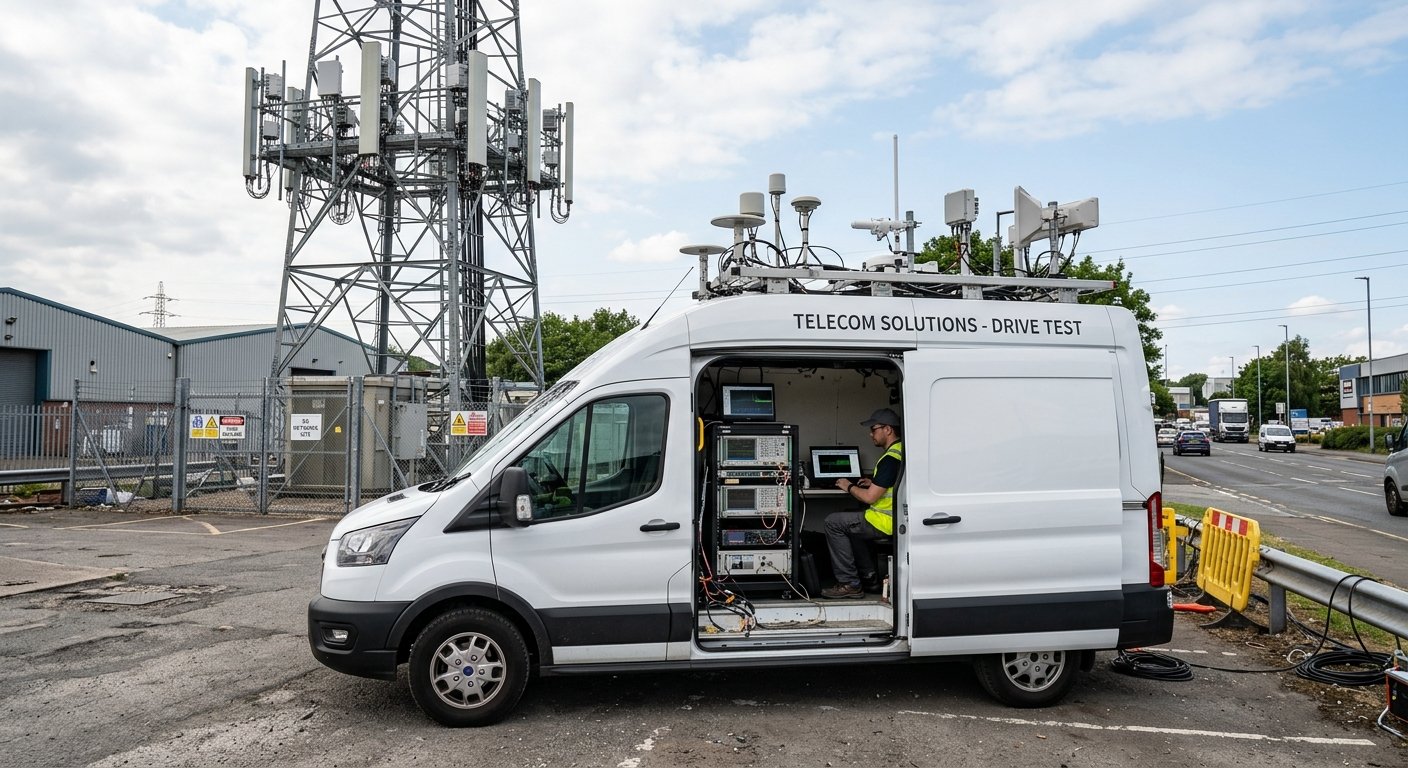
Drive testing for VoLTE is a well-established workflow: mobile-originated and mobile-terminated call generation along defined routes, with logging of RAT, cell ID, signaling, and RTP KPIs at every point. Dingli's LTE drive test solutions measure coverage, signal quality, throughput, handover and service experience along these defined test routes.
Drive testing for VoNR adds a layer of complexity. It requires SA-capable test devices and actual SA coverage along the route, plus explicit fallback detection logic. A route planned as a 'VoNR test route' may contain SA coverage holes that silently turn calls into VoLTE calls without any obvious signal in the summary report.
Before committing to an expensive field campaign, voice call flows can be validated in controlled lab conditions to catch signaling or interoperability issues early. Dingli's Laboratory Automation solutions support verifying 4G/5G performance and reliability before deployment, which is the logical first gate before field testing.
For ongoing benchmarking as VoNR coverage expands, continuous call generation lets engineers track network behavior over time rather than relying on a single snapshot. Dingli's Autonomous Measurement solution supports this kind of continuous monitoring and validation of network performance over time.
Use this as a quick reference when scoping a test plan or briefing a field team on what to expect from each technology.
| Parameter | VoLTE | VoNR |
|---|---|---|
| Underlying RAT | LTE | 5G NR, SA required |
| Signaling path | SIP over dedicated EPS bearer | SIP over 5G QoS flow |
| Required network mode | Any LTE coverage | 5G SA only |
| Fallback risk | None | High, EPS fallback possible |
| Test equipment requirement | Standard LTE test device | SA-capable device with VoNR flag |
If you only remember one row, make it the equipment requirement row. A test device that can't confirm SA registration and VoNR support will never tell you the difference between a native VoNR call and a fallback call.
As networks transition from LTE to 5G SA, test campaigns should expect a realistic mix of native VoNR calls, native VoLTE calls, and fallback calls, all in the same route or the same day. Report results segmented by call type rather than as one blended average, otherwise the numbers will flatten out real problems.
The fullest picture comes from layering three stages: pre-launch lab validation to catch signaling and interop issues early, drive testing to capture real-world RF and fallback behavior, and ongoing automated monitoring to track how VoNR coverage and performance evolve as SA footprint expands.
Dingli's 5G Private Network Testing and Multiple Network Benchmarking solutions, alongside VoLTE/VoNR MOS Testing, LTE/5G drive test tools, and autonomous measurement products, give engineering teams the components needed to validate voice quality across both network generations rather than just one.
Engineers planning a VoLTE/VoNR validation campaign can review the relevant testing solutions and product documentation on Dingli's support portal before scoping equipment and test routes.
This is a device/network configuration decision, not a testing choice. For validation purposes, engineers should test both the native VoNR path and the EPS fallback path, since real subscribers will experience both depending on their position relative to SA coverage at any given moment.
VoLTE's bearer-based QoS model and its role as the fallback target when 5G SA voice isn't available can add extra call setup delay compared to native VoNR. This is an architectural trade-off engineers should factor into call setup time benchmarks rather than expecting parity with VoNR.
This compares two different things. LTE is the radio access network; VoLTE is the voice service that runs over it via IMS and SIP signaling instead of the legacy circuit-switched fallback. VoLTE is the modern standard for voice on LTE networks, not a competing alternative to LTE itself.



If you are interested in our services or need customized solutions, please feel free to contact us
Contact UsComplete the form below to have a sales person address your business needs.

