
Support Portal
Discover our Support Portal, your one-stop destination for accessing essential resources such as brochures, product datasheets, operation guides, and more.
Explore
Pilot Wireless Network

Small Cell

Drive Test/Outdoor Test

Indoor Test

Autonomous Measurement

Laboratory Automation

Post Processing

Drone-based Testing
Dingli's Pilot Wireless Network Solution is instrumental in ensuring seamless signal transmission between base stations and mobile devices. This cutting-edge solution is tailored to improve the performance, reliability, and efficiency of wireless networks, delivering enhanced network quality and user experience.
Read More Find the related productsSmall Cell Networks power the next wave of wireless innovation, delivering high-quality, reliable connectivity for demanding environments like smart enterprises and hospitals
Read More Find the related productsDingli's LTE drive test solutions give mobile operators real-world visibility into outdoor 4G and 5G performance, measuring coverage, signal quality, throughput, handover and service experience along defined test routes.
Read More Find the related productsIndoor cellular coverage tester solutions evaluate and optimize networks in malls, hospitals, offices, residences, schools, and underground parking lots.
Read More Find the related productsAutonomous Measurement uses advanced tools to monitor and validate network performance, streamlining evaluation and reducing manual effort.
Read More Find the related productsLab test solutions verify 4G/5G performance and reliability before deployment, ensuring every component meets the highest standards
Read More Find the related productsDingli provides cutting-edge Post Processing solutions and a powerful software platform for network analysis and benchmarking, maximizing performance and reliability.
Read More Find the related productsDingli Drone-Based Testing is an automated solution designed for the emerging low-altitude economy, enabling precise 5G vertical coverage analysis.
Read More Find the related products
Enables seamless smart applications, reliable connectivity, and enhanced driving safety

This cost-effective NB-IoT testing and eMTC testing solution includes essential measurements, signaling tests, failure alarms, and post-processing.

Measure QoS and QoE for all OTT applications and services

Accelerate digital transformation with 5G private network testing that improves reliability, efficiency and productivity.

Measures and analyzes network performance for low-altitude cellular networks

Verify QoE in 5G networks with a scalable multiple network benchmarking solution and ensure the competitiveness of your network.

Increase the efficiency of your site verification and accelerate your 5G roll-out

Ensure network quality and end-user satisfaction of wireless networks with professional in-building measurement

Automated VoLTE testing gives mobile voice service providers an end-to-end way to measure voice quality and improve customer experience.

Ensure the performance of your 5G network indoors, benchmark your network against competitors

Dingli enhances outdoor network coverage with advanced 4G-5G RAN solutions, bridging the digital gap for urban and rural areas.

Dingli's Private Network Solutions offer secure, customizable, and efficient wireless communication for businesses, enhancing connectivity and operational efficiency.

Dingli's IoT Solutions offer innovative and scalable Internet of Things technologies, enabling smart connectivity and data-driven insights across various industries.

FWA, Fixed Wireless Access, provides high-speed broadband internet via wireless communication, bridging the digital divide in underserved areas.

Dingli excels in Indoor Network solutions, merging 4G reliability with swift 5G speeds for seamless mobile coverage in businesses and public spaces.

Elevator Networks, designed for elevators, uses 5G for high-speed connectivity, real-time monitoring, and seamless communication.

The Pinglu Canal officially opened to navigation on September 16, 2026, marking a major milestone for China's inland-to-sea connectivity. Stretching approximately 134.2 km from Guangxi to the Beibu Gulf, the canal is a backbone project of the New Western Land-Sea Trade Corridor and is designed to accommodate vessels of up to 5,000 tonnes. [External Link: Pinglu Canal officially opens to navigation]
Beyond its role as a major transportation corridor, the Pinglu Canal is also becoming part of a more connected and digitally enabled waterway environment. Recent reports highlight the use of technologies including BeiDou navigation, cloud computing, and AI to support navigation monitoring and risk management. [External Link: Smart and digital technologies on Pinglu Canal]
As connected applications become increasingly important for waterway operations, reliable mobile connectivity becomes another important part of the infrastructure.
Smart waterway monitoring, data transmission, HD video, daily communications, and emergency response all depend on stable wireless connectivity.
But this raises a practical question:
How can mobile network performance be accurately tested in a waterway environment where conventional road-based drive testing cannot reach?
This is where UAV-based 5G network testing can provide a valuable complementary approach.

Conventional mobile network testing is typically performed using vehicles traveling along roads and other accessible routes. This approach works well for many terrestrial environments, but waterways introduce a different testing challenge.
A vehicle can test network performance along a shoreline, but it cannot directly measure network conditions in the center of a waterway.
For a major transportation corridor such as the Pinglu Canal, however, the actual operating environment is the waterway itself.
This creates a gap between:
Where conventional testing can go
and
Where network connectivity is actually being used.
UAV-based network testing provides a way to bridge this gap.
By mounting a lightweight professional network testing device on a UAV, network measurements can be collected directly within areas that are difficult or impractical to access using conventional ground-based testing methods.
A UAV-based network testing system combines three key elements:
UAV platform + airborne network testing device + network testing and analysis software
The UAV provides flexible access to the target testing environment, while the airborne testing device performs professional wireless network measurements during flight.
This approach can support network testing in a range of challenging environments, including:
For waterway applications, the key advantage is straightforward:
The testing system can move beyond the shoreline and measure network performance directly in the actual waterway environment.
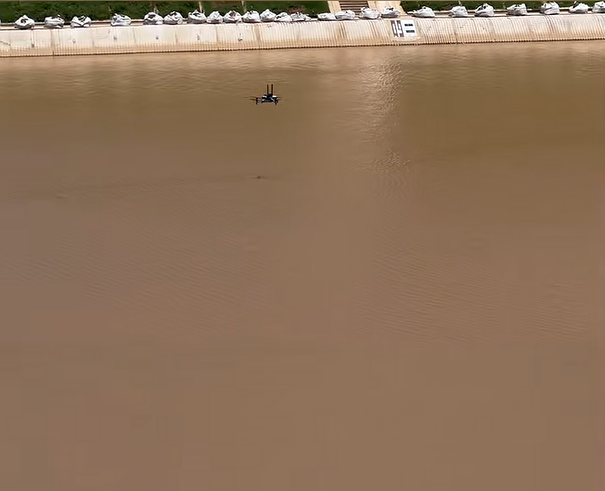
To conduct the pilot test, China Mobile Guangxi Qinzhou Branch deployed Dingli Pilot AirTest, a lightweight airborne network testing device designed for UAV-based wireless network measurement.
Pilot AirTest enables professional network measurements to be collected while the UAV is in flight, helping extend conventional mobile network testing capabilities into environments that are difficult to access from the ground.
For the Pinglu Canal pilot test, the system was used to collect and analyze key 5G network and service performance indicators, including:
This allows operators to evaluate connectivity from the perspective of the actual operating environment rather than relying solely on measurements collected along nearby roads.
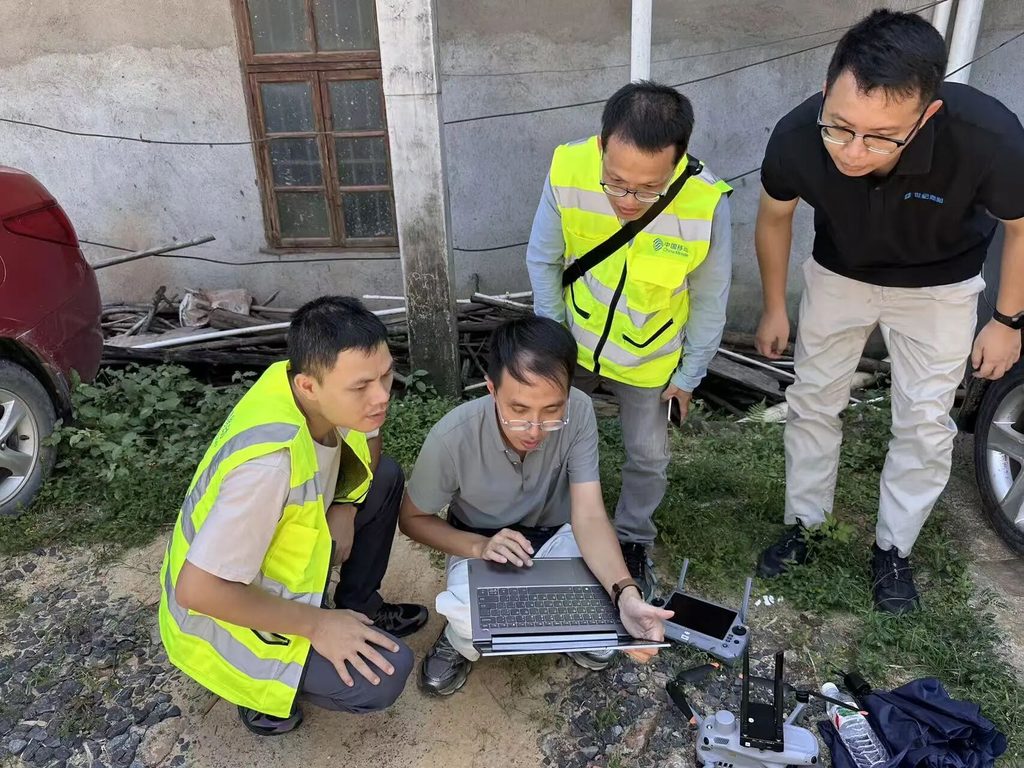
As part of a special 5G network experience test, China Mobile Guangxi Qinzhou Branch mounted Pilot AirTest on a UAV and conducted a pilot flight test over a section of the Pinglu Canal.
The UAV entered the center of the waterway and conducted 5G network measurements approximately 5–10 meters above the water surface.
| Parameter | Test Configuration |
| Testing Scenario | Pinglu Canal waterway |
| Testing Device | Dingli Pilot AirTest |
| Test Method | UAV-based 5G network testing |
| Pilot Test Section | Approx. 2 km |
| Test Altitude | Approx. 5–10 m above water |
| Network | 5G |
The approximately 2 km section was an initial pilot test section, rather than the total testing scope of the Pinglu Canal.
The purpose of this pilot was to validate the feasibility of using UAV-based network testing in the actual waterway environment and establish a practical foundation for subsequent routine network testing and network assurance across the full canal.
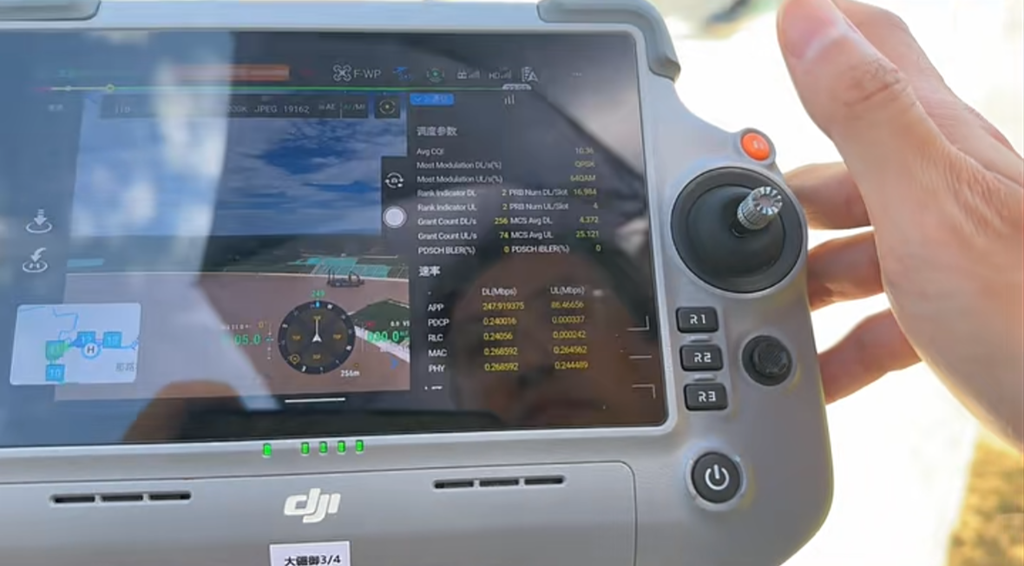
The initial UAV-based test demonstrated strong 5G network performance in the tested waterway section.
The measured network performance indicates that the tested 5G connectivity can support a range of smart waterway applications, including data transmission, HD video transmission, daily communications, and emergency communications.
More importantly, the pilot demonstrated the feasibility of bringing professional network measurement capabilities directly into the waterway environment.
The Pinglu Canal pilot highlights an important difference between conventional ground-based testing and UAV-based network testing.
Road → Vehicle → Shoreline → Network Measurement
UAV → Airborne Testing Device → Waterway → Network Measurement
The UAV-based approach does not replace conventional drive testing. Instead, it provides a complementary method for testing areas that are difficult to cover from the ground.
For waterway operators and mobile network teams, this creates a more flexible way to assess connectivity along actual waterborne operating routes.
The approach can help support:
The value of the Pinglu Canal project extends beyond the initial 2 km flight test.
The pilot test validated the UAV-based network testing methodology and provided a foundation for future routine testing and network assurance across the full Pinglu Canal.
A potential testing workflow can evolve from:
Pilot Testing
↓
Method Validation
↓
Routine UAV-Based Network Testing
↓
Coverage Assessment & Optimization
↓
Full-Waterway Network Assurance
As the canal enters regular operation and connected applications continue to develop, ongoing network testing can provide operators with visibility into network performance across different sections and operating environments.
This is particularly relevant for smart waterway applications that depend on reliable mobile connectivity for monitoring, data transmission, communications, and emergency response.
The development of modern waterways is increasingly moving beyond physical transportation infrastructure.
Digital monitoring, intelligent navigation, connected vessels, remote operations, and data-driven management are becoming increasingly important components of waterway operations. Recent reporting on the Pinglu Canal has highlighted the role of digital technologies in navigation monitoring and risk management. [External Link: Pinglu Canal’s role in regional connectivity]
In this environment, network connectivity becomes part of the operational infrastructure.
Reliable 5G connectivity can support applications such as:
This also means that network testing needs to evolve with the infrastructure itself.
Instead of limiting measurements to roads and shorelines, UAV-based network testing provides an additional way to evaluate connectivity where the network is actually being used.
The Pinglu Canal pilot demonstrates a broader principle that applies beyond a single waterway project:
When the operating environment changes, the network testing methodology needs to evolve with it.
For waterways, offshore areas, low-altitude environments, and other locations with limited ground access, UAV-based testing can extend professional network measurement into areas that conventional testing methods may not easily reach.
With a lightweight airborne testing device such as Pilot AirTest, operators can collect network data from the actual operating environment and use the results to support coverage assessment, optimization, and long-term network assurance.
For large-scale connected infrastructure, this provides a practical path from pilot validation to continuous network performance management.
The Pinglu Canal 5G pilot test demonstrates how UAV-based 5G network testing can complement conventional ground-based measurement and extend network testing into real-world waterway environments.
Using Dingli Pilot AirTest mounted on a UAV, China Mobile Guangxi Qinzhou Branch conducted an initial approximately 2 km pilot test at 5–10 meters above the water surface and achieved measured 5G downlink speeds above 240 Mbps and uplink speeds above 80 Mbps.
The objective was not simply to measure network speed, but to validate a more flexible approach to network testing in an environment where conventional road-based methods have natural limitations.
As connected and smart waterway applications continue to evolve, UAV-based network testing can provide an effective tool for 5G coverage assessment, network optimization, and ongoing network assurance.
From Shore to Waterway.
From Pilot Testing to Full-Waterway Network Assurance.
Want to bring professional network testing into challenging environments?
Discover how Dingli's UAV-Based Network Testing Solution combines airborne network measurement with intelligent data analysis to support 4G, 5G, and low-altitude connectivity assessment.
CTA:
Explore the UAV-Based Network Testing Solution →
Recommended internal-link anchor text:


If you are interested in our services or need customized solutions, please feel free to contact us
Contact UsComplete the form below to have a sales person address your business needs.

