
Support Portal
Discover our Support Portal, your one-stop destination for accessing essential resources such as brochures, product datasheets, operation guides, and more.
Explore
Pilot Wireless Network

Small Cell

Drive Test/Outdoor Test

Indoor Test

Autonomous Measurement

Laboratory Automation

Post Processing

Drone-based Testing
Dingli's Pilot Wireless Network Solution is instrumental in ensuring seamless signal transmission between base stations and mobile devices. This cutting-edge solution is tailored to improve the performance, reliability, and efficiency of wireless networks, delivering enhanced network quality and user experience.
Read More Find the related productsSmall Cell Networks power the next wave of wireless innovation, delivering high-quality, reliable connectivity for demanding environments like smart enterprises and hospitals
Read More Find the related productsDingli's LTE drive test solutions give mobile operators real-world visibility into outdoor 4G and 5G performance, measuring coverage, signal quality, throughput, handover and service experience along defined test routes.
Read More Find the related productsIndoor cellular coverage tester solutions evaluate and optimize networks in malls, hospitals, offices, residences, schools, and underground parking lots.
Read More Find the related productsAutonomous Measurement uses advanced tools to monitor and validate network performance, streamlining evaluation and reducing manual effort.
Read More Find the related productsLab test solutions verify 4G/5G performance and reliability before deployment, ensuring every component meets the highest standards
Read More Find the related productsDingli provides cutting-edge Post Processing solutions and a powerful software platform for network analysis and benchmarking, maximizing performance and reliability.
Read More Find the related productsDingli Drone-Based Testing is an automated solution designed for the emerging low-altitude economy, enabling precise 5G vertical coverage analysis.
Read More Find the related products
Enables seamless smart applications, reliable connectivity, and enhanced driving safety

This cost-effective NB-IoT testing and eMTC testing solution includes essential measurements, signaling tests, failure alarms, and post-processing.

Measure QoS and QoE for all OTT applications and services

Accelerate digital transformation with 5G private network testing that improves reliability, efficiency and productivity.

Measures and analyzes network performance for low-altitude cellular networks

Verify QoE in 5G networks with a scalable multiple network benchmarking solution and ensure the competitiveness of your network.

Increase the efficiency of your site verification and accelerate your 5G roll-out

Ensure network quality and end-user satisfaction of wireless networks with professional in-building measurement

Automated VoLTE testing gives mobile voice service providers an end-to-end way to measure voice quality and improve customer experience.

Ensure the performance of your 5G network indoors, benchmark your network against competitors

Dingli enhances outdoor network coverage with advanced 4G-5G RAN solutions, bridging the digital gap for urban and rural areas.

Dingli's Private Network Solutions offer secure, customizable, and efficient wireless communication for businesses, enhancing connectivity and operational efficiency.

Dingli's IoT Solutions offer innovative and scalable Internet of Things technologies, enabling smart connectivity and data-driven insights across various industries.

FWA, Fixed Wireless Access, provides high-speed broadband internet via wireless communication, bridging the digital divide in underserved areas.

Dingli excels in Indoor Network solutions, merging 4G reliability with swift 5G speeds for seamless mobile coverage in businesses and public spaces.

Elevator Networks, designed for elevators, uses 5G for high-speed connectivity, real-time monitoring, and seamless communication.

The telecommunications industry is currently witnessing a massive leap forward. As we transition from standard 5G to 5G-Advanced (5.5G), one acronym is dominating the conversation: 3CC.
But to truly understand why 3CC (Three Component Carrier Aggregation) is a game-changer capable of delivering 5Gbps+ download speeds, we must first look under the hood of the underlying technology: Carrier Aggregation (CA).
Whether you are a tech enthusiast curious about why your new Samsung Galaxy S25 is so fast, or a network engineer looking for the latest mobile network testing solutions for Qualcomm X80 chipsets, this comprehensive guide covers it all.
Before we talk about "3CC" or "5.5G," let's answer the fundamental question: What is Carrier Aggregation?
In the early days of mobile networks, data transmission was simple but inefficient. Imagine a single-lane road. No matter how fast the car (data) travels, if the road (frequency band) is narrow, only a limited number of cars can pass through at once. If the lane gets jammed, everything stops.
Carrier Aggregation (CA) changes the physics of this road.
Mobile operators often own "fragmented" spectrum—a bit of frequency here (e.g., 700MHz), and a bit of frequency there (e.g., 3.5GHz). Without CA, a phone can only use one frequency block at a time.
Carrier Aggregation acts as a "virtual glue." It allows the network to combine these separate, fragmented frequency bands into one single, wider virtual data pipe.
Analogy: Think of CA as expanding a single-lane road into a multi-lane superhighway. By opening up more lanes simultaneously, traffic flows faster, and the capacity increases exponentially.
While CA was introduced in the 4G LTE era (LTE-Advanced), it is the lifeline of 5G.
Speed: Wider bandwidth directly equals faster throughput (Mbps/Gbps).
Efficiency: It allows operators to utilize their disparate spectrum assets fully, rather than letting some bands sit idle.
To the user, CA feels like magic—your download finishes instantly. But in the background, a complex negotiation is happening between the Base Station (gNodeB) and your User Equipment (UE/Smartphone).
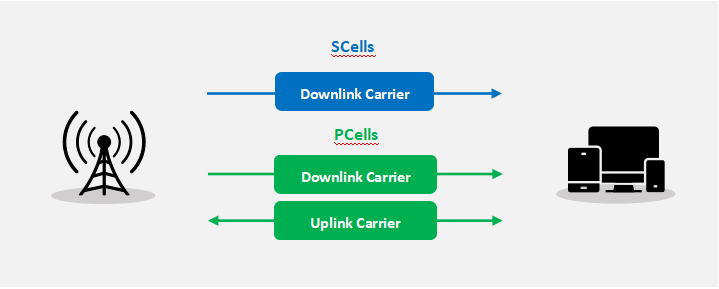
Carrier Aggregation doesn't treat all frequencies equally. It assigns them specific roles:
This is the "Anchor" carrier. It is the main connection responsible for the Control Plane (RRC signaling).
It manages the connection stability, handovers, and security.
Key Characteristic: Usually a lower frequency (e.g., 700MHz or 2.1GHz) because low bands cover a wider area and penetrate walls better, ensuring the connection doesn't drop.
These are the additional carriers activated solely for the User Plane (Extra Data).
The network activates Scells only when you need high bandwidth (e.g., streaming 4K video). When the data demand drops, the Scells deactivate to save resources.
Key Characteristic: Usually mid-to-high frequencies (e.g., 3.5GHz or 4.9GHz) that offer massive capacity but smaller coverage.
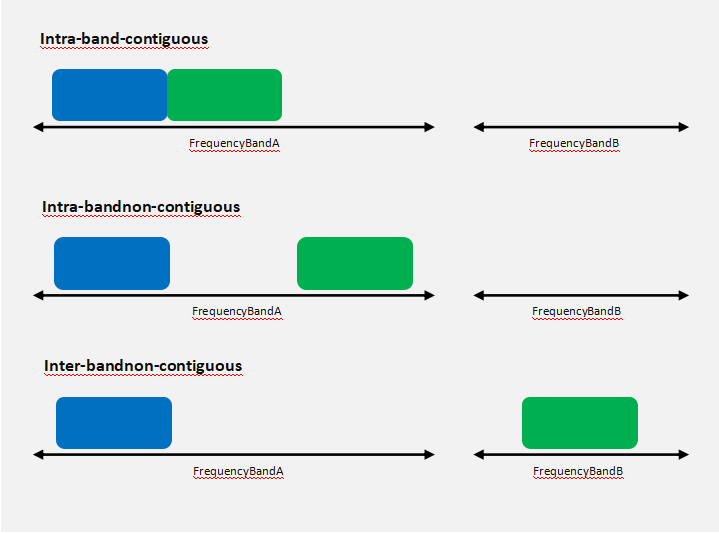
Not all spectrum combinations are the same. Understanding the three types of CA is crucial to understanding why 3CC is so powerful.
The Scenario: The operator owns a large, continuous block of spectrum (e.g., 100MHz of 3.5GHz).
The Method: They combine adjacent channels side-by-side.
Difficuty: Low. It’s like widening a road by paving the grass right next to it.
The Scenario: The operator has two blocks of spectrum in the same frequency band, but they are separated by another operator’s spectrum.
The Method: The device uses two radios to transmit/receive on the same band but at different gaps.
Difficulty: Medium.
The Scenario: Combining totally different frequency ranges, such as Low Band (sub-1GHz) + Mid Band (C-Band).
The Method: This is the most complex but most valuable type.
The Benefit: It combines the Coverage of low bands with the Capacity of mid bands. This is the foundation of modern 5G-A 3CC networks.
Now that we understand the basics, let's look at 3CC (Three Component Carrier Aggregation), the flagship feature of 5G-Advanced.
While standard 5G might use 2CC (Two carriers), 3CC pushes the limit further by aggregating three distinct bands.
A common deployment strategy we see operators testing today involves:
Carrier 1 (Pcell): n28 (700MHz) - Ensures you stay connected in elevators.
Carrier 2 (Scell): n78 (3.5GHz - 100MHz) - Provides raw speed.
Carrier 3 (Scell): n78 (3.5GHz - 100MHz) - Doubles the raw speed.
Total Bandwidth: 200MHz + Low Band = Massive Throughput.
With 3CC, we are moving beyond the "Gigabit" era.
Peak Downlink: Theoretical speeds exceed 5Gbps.
User Experience: This enables Naked-eye 3D, XR Metaverse, and 8K Live Streaming without buffering.
Theoretically, 3CC sounds perfect. But in the real world, radio waves are unpredictable.
Does the network successfully activate all three carriers?
Is the Pcell managing the signaling correctly?
Are we getting the maximum Throughput (Mbps) possible?
This is where Dingli steps in. We provide professional Network Performance Testing solutions that validate these metrics using the latest commercial smartphones.
To test a cutting-edge network, you need cutting-edge devices. Dingli’s software solutions (Pilot Pioneer and Pilot Walktour) are fully compatible with the latest Qualcomm Snapdragon X75 and X80 modem-RF systems.
We support 3CC verification on the newest flagships:
Samsung Galaxy S25 / S25 Ultra (X80)
Xiaomi 15 / 15 Pro / 15 Ultra (X80)
Samsung Galaxy S24 Series (X75)
vivo X100 Pro (X75)
For 3CC Drive Testing, Pilot Pioneer provides deep visibility into the Radio Access Network (RAN).
Throughput Visualization: Watch real-time data rates climb past 4Gbps as the software aggregates data streams from all three carriers.
Layer 3 Decoding: Our software decodes the complex RRC signaling messages. You can see the exact moment the network sends the RRCConnectionReconfiguration message to add the Scells.
Resource Block (RB) Analysis: Verify if the network is allocating sufficient Resource Blocks to the user to maintain high speeds.
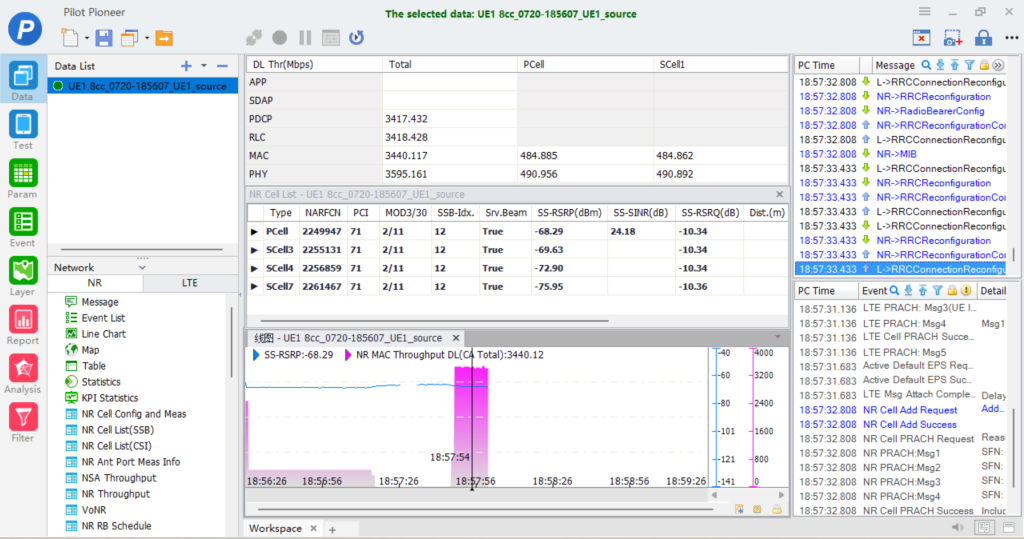
[ Pilot Pioneer Interface showing a speedometer hitting 5Gbps and a graph of 3 active carriers]
3CC is critical for indoor coverage where signals often degrade. Pilot Walktour runs directly on Android devices (like the Xiaomi 15 Pro), allowing engineers to perform "Walk Tests" in subways, malls, and offices.
CA Activation Monitoring: The "CA View" on Pilot Walktour clearly shows the status of the Pcell and Scells.
Green: Active and transmitting data.
Grey: Configured but inactive.
Red: Signal too weak to aggregate.
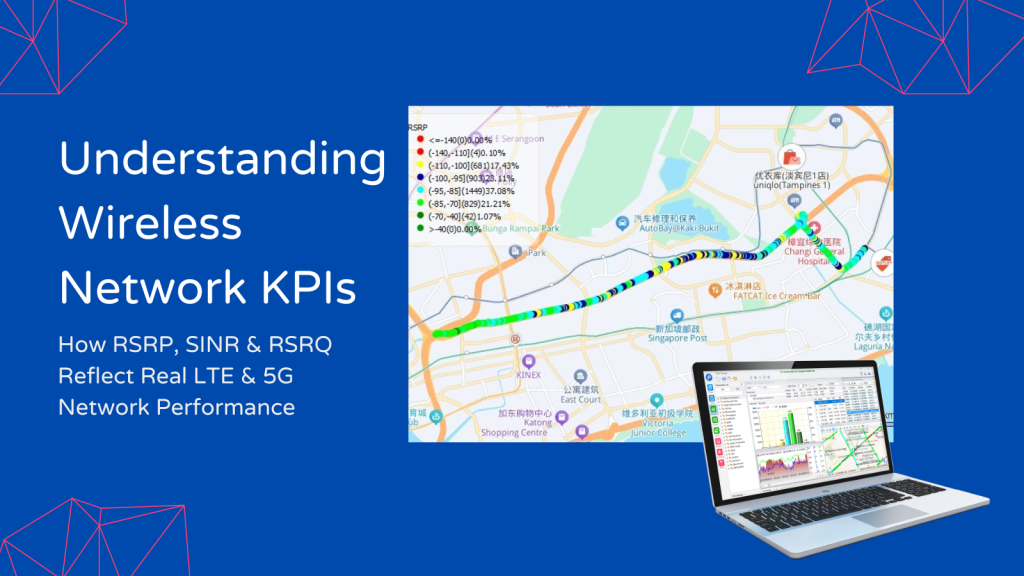
Blind Zone Detection: By monitoring the RSRP (Reference Signal Received Power) and SINR (Signal to Interference & Noise Ratio) of each component carrier, engineers can identify "dead zones" where the 3CC aggregation breaks down.
FTP/HTTP Business Testing: Run automated file transfer tests to measure the actual user experience (QoE) and latency in a loaded 3CC network.
5G-A 3CC is not just a spec update; it is the infrastructure that will carry the next decade of digital innovation. But a "Three-Lane Superhighway" is only useful if it's paved correctly.
For Mobile Network Operators and System Vendors, validating 3CC performance is no longer optional. With Dingli’s Pilot Pioneer and Pilot Walktour, coupled with the power of Qualcomm’s X80 ecosystem, you have the precise tools needed to visualize, analyze, and optimize the 5.5G experience.
Ready to test the limit? Discover how Dingli can help you verify 3CC on the Samsung S25 and Xiaomi 15 today!
Q: What is the difference between 5G CA and 5G-A 3CC?
A: Standard 5G CA often involves 2 carriers (2CC). 5G-A 3CC aggregates three distinct carriers, offering significantly higher bandwidth and throughput (often exceeding 5Gbps).
Q: Does Dingli software test phone overheating?
A: No. Dingli solutions focus exclusively on Telecommunications Network Performance. We measure metrics like Signal Quality (SINR), Data Throughput (Mbps), and Signaling Success Rates, not device hardware thermals or battery health.
Q: Which devices can I use with Pilot Walktour for 3CC testing?
A: Pilot Walktour supports a wide range of devices, including the latest Samsung Galaxy S25 Ultra, Xiaomi 15 Ultra, and vivo X100 Pro. Please contact our support team for the full supported device matrix.




If you are interested in our services or need customized solutions, please feel free to contact us
Contact UsComplete the form below to have a sales person address your business needs.

